Decision Models (System One) from Scratch.
Teach a frozen LLM to choose between options in a single pass.
- parts
- 5
- reading time
- 91 min
- level
- Intermediate
- status
- complete
- last part
- Nov 2026
About this series
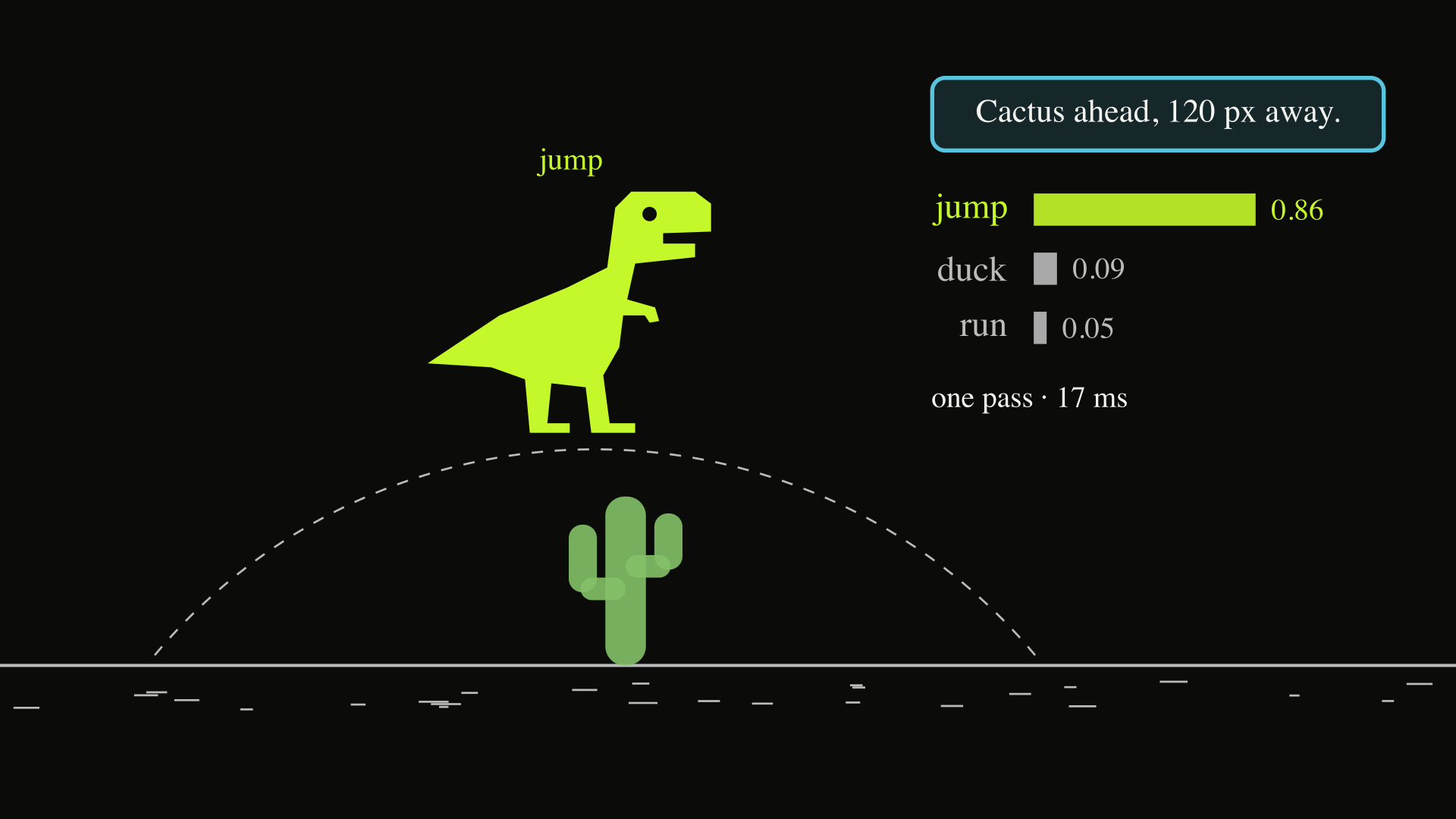
Most of what we ask language models to do today goes through writing: the model thinks out loud, token after token, and the answer comes at the end. That is powerful, and slow. Many decisions do not need it. An agent picking its next command, a verifier choosing the best of four attempts, a game character deciding to jump: these are choices between options, and they can be made in one glance.
This series rebuilds a decision model, also called a System One model, that does exactly that. We keep a large language model frozen, train two small networks on top of it, and end up with a model that returns a probability for each option in a single pass. Each part mixes intuition, the equations that matter, and the code that trained it. Read them in order if you are new to contrastive learning, or jump to the part you need.
The parts
Read in order, each part builds on the previous one.
- 01
What Is a Decision Model (System One)?
Language models that think out loud are slow. A decision model skips the writing: give it a situation and a list of options, and it returns a probability for each one in a single pass.
13 min read read → - 02
Fine-Tuning a Frozen LLM: Why We Train Heads Instead of LoRA
Our decision model never changes a single weight of its 8-billion-parameter language model. Here is why training two small heads on frozen embeddings suits this job better than LoRA, and how a frozen model turns text into a vector.
19 min read read → - 03
Contrastive Learning: InfoNCE, Temperature and Hard Negatives
How two small heads learn to put a question next to its answer, using nothing but matching pairs: the in-batch similarity matrix, the InfoNCE loss, the temperature, and the hard negatives that make the model sharp.
17 min read read → - 04
Training a Decision Model: The Data, and Pre-, Mid- and Post-Training
Where the training pairs come from, how a terabyte of vectors is fed to one GPU, the three training stages, and the general post-training recipe that worked best: terminal steps, agent environments, Q&A replay and answer preferences with critiques.
25 min read read → - 05
Does It Work? A Verifier for Coding Agents, the Results, and What We Learned
Our decision model against the released CLM-8B: tricky questions, choosing between a coding agent's attempts, and a game played in real time. And the lessons, including the ones the benchmarks taught us about themselves.
17 min read read →